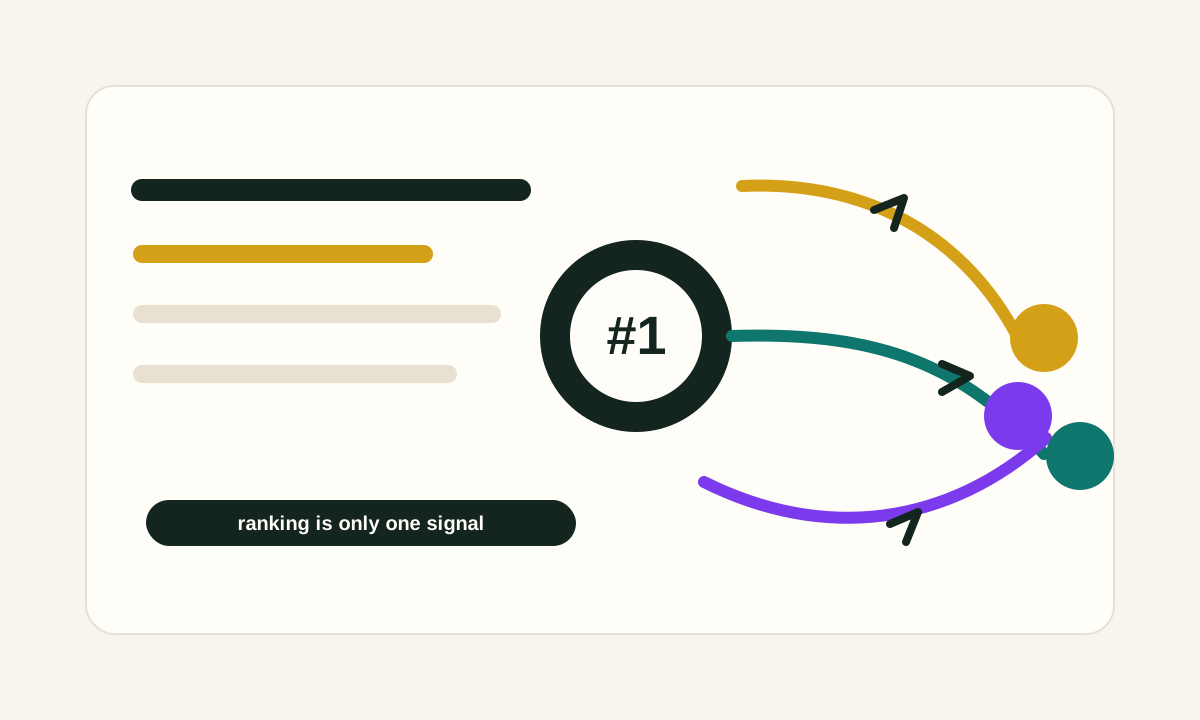
If your business ranks #1 on Google, that is still worth celebrating. It means your site has earned trust, relevance, and visibility in a traditional search result.
But AI search is not a traditional search result. AI Overviews, AI Mode, ChatGPT search, Perplexity, Gemini, and Copilot do not simply copy the blue-link ranking order. They assemble answers from sources they can understand, retrieve, compare, and cite.
That changes the game for local businesses. Ranking helps. It just is not the same thing as being selected as an AI citation.
The old promise was simple
For years, the goal was clear: get on page one, then fight for the top three positions. If you ranked higher, you usually won more attention.
AI search weakens that promise. The user may never see ten blue links. They may see a generated answer, a short citation list, a follow-up prompt, or a recommendation that blends several sources into one response.
The new data is uncomfortable
Ahrefs analyzed 863,000 keyword SERPs and 4 million AI Overview URLs. Their March 2026 update found that only about 38% of URLs cited in Google AI Overviews also appeared in the top 10 result blocks for the same query.
That does not mean organic SEO is dead. It means the citation layer has separated from the ranking layer. A page can rank and still be skipped. Another page can be cited because it answers an adjacent question more clearly.
The picture gets even sharper in Google AI Mode. Moz/STAT's AI Mode research reported that exact URL overlap with Google's top 10 organic results was only 12% across nearly 40,000 queries.
Short answer
Your #1 Google ranking still matters, but it is no longer enough. AI search rewards pages and brands that are easy to understand, easy to cite, useful across related questions, and trusted beyond one keyword.
Why AI search picks different sources
AI search systems often use query fan-out. Instead of answering only the exact phrase someone typed, the system expands the question into related sub-questions, retrieves sources for those angles, and then builds a synthesized answer.
Imagine someone searches for "best emergency plumber near me." Traditional SEO might focus on that one phrase. AI search may also look for service area, response time, reviews, licensing, common emergency services, pricing context, and whether the business has pages that clearly explain those topics.
The winner is not always the page with the strongest keyword position. It may be the source that is easiest for the machine to trust and reuse.
What does matter in AI search
For a small business website, the practical work is not mystical. It is clarity. Machines need to know who you are, what you do, where you do it, why you are credible, and which page answers which buyer question.
AI visibility checklist
- clear business identity, service area, phone, and contact path
- specific service pages instead of one vague services page
- schema markup that matches visible page truth
- helpful answers to adjacent buyer questions
- fast mobile pages that can be crawled and understood
- consistent profiles, reviews, and off-site mentions
- content that makes the business easy to compare and recommend
Ranking is an input, not the finish line
The mistake is treating a ranking report as the whole scoreboard. In AI search, you also need to ask better questions:
- Is the business entity obvious?
- Can a machine identify each service without guessing?
- Do pages answer the follow-up questions a real buyer would ask?
- Do citations, profiles, reviews, and local signals support the same story?
- Would an AI system have a clean reason to cite this page over a competitor?
What this means for local businesses
A plumber, dentist, roofer, electrician, cleaner, remodeler, or accountant does not need a giant content machine. The first wins are usually much more basic.
Build a clean site. Separate your services. Mark up the business correctly. Show real proof. Keep pages fast. Make the location and next step obvious. Publish useful answers that sound like your customers, not like an SEO spreadsheet.
That is how you become easier to cite. And in AI search, being citable is becoming just as important as being rankable.
The bottom line
Your Google ranking is still a valuable signal. It can help AI systems discover and trust your site. But the future of search is not only about owning position #1 for one keyword. It is about being the clearest, most trustworthy answer across the full path a buyer takes before they choose.
FAQ
Does SEO still matter in AI search?
Yes. SEO still matters because AI search systems need crawlable, trusted, well-structured sources. The change is that ranking for one exact keyword is no longer the same thing as being selected as a citation.
Can a local business appear in AI answers without ranking number one?
Yes. AI systems often pull from related queries, entity signals, structured pages, and trusted off-site sources. A business can improve its odds by making services, locations, proof, and expertise easier to understand and cite.
What should a small business fix first for AI search visibility?
Start with entity clarity, service pages, schema markup, fast mobile performance, consistent profiles, and useful answers to the questions buyers actually ask before they call.
Want to Know if AI Search Can Understand Your Business?
We audit small business websites for schema gaps, trust leaks, mobile speed, service clarity, and AI search visibility.
Request an AI Visibility Audit